
Integrated Ammonia and Glycol Industrial Refrigeration System Installation
Multidisciplinary ammonia and glycol refrigeration project for Mayekawa at a Coca-Cola plant, including piping, power, rigging, and testing.
- Client
- Mayekawa
- Country
- Guatemala
STAR was contracted by Mayekawa to participate in the installation and integration of an industrial refrigeration system at a Coca-Cola plant. Due to its scale, the project required coordinated work across refrigeration, piping, electrical power, and mechanical installation, bringing together major equipment, distribution networks, structural systems, and auxiliary services within a single solution.
The intervention extended beyond the installation of an individual machine. The scope included expansion of the existing infrastructure and interconnection of the different components forming the refrigeration system. Work was carried out simultaneously inside the machinery room, on exterior structures, along elevated routes, inside electrical rooms, and at connection points distributed throughout the plant.
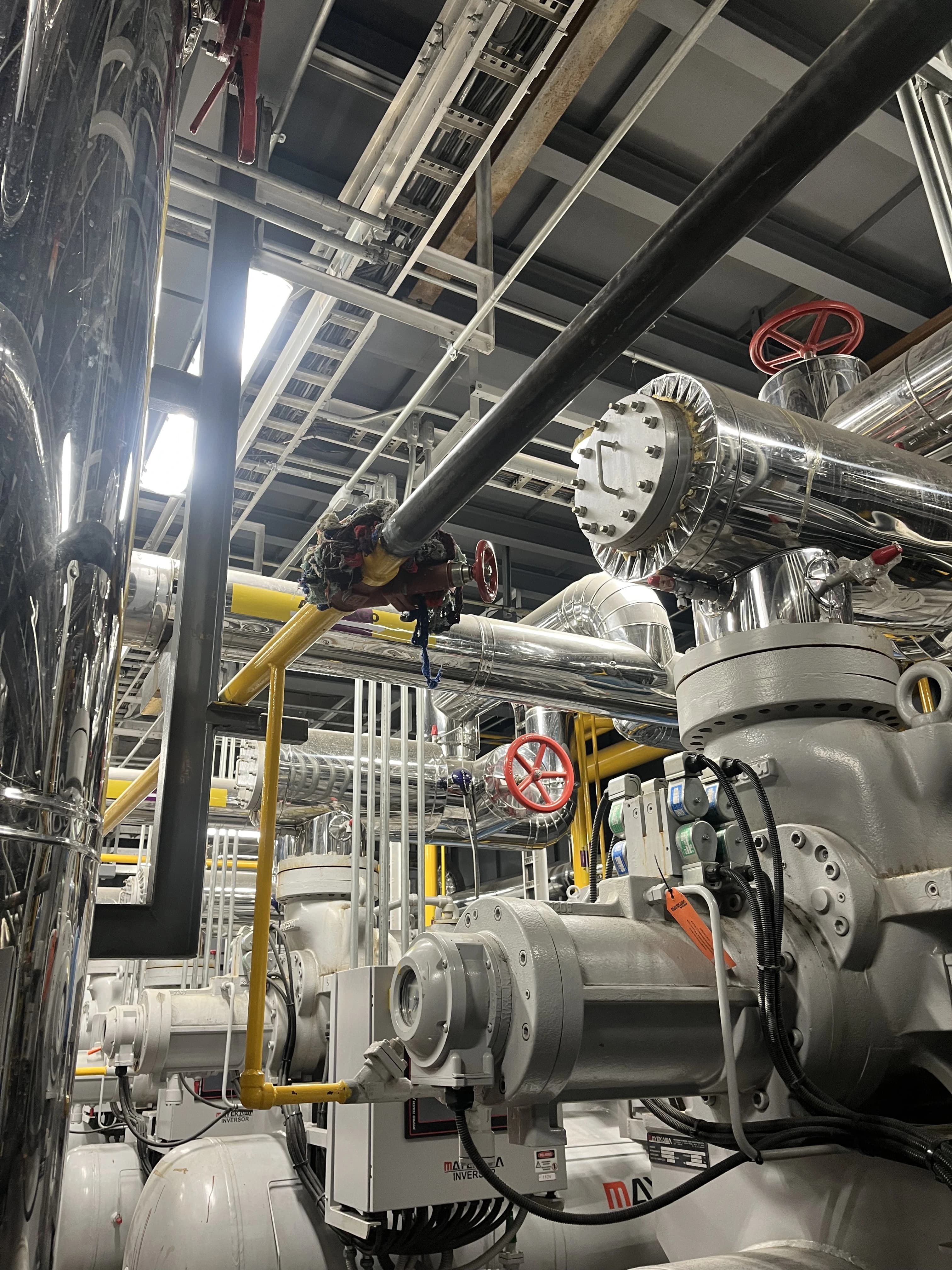
The system incorporates Mayekawa compression equipment, a Güntner condenser, receivers, valves, instrumentation, and an extensive piping network. Its configuration combines a primary ammonia refrigeration circuit with a secondary glycol circuit used to distribute cooling capacity to the areas served by the installation.
As part of the mechanical scope, STAR participated in receiving, moving, lifting, and positioning large industrial equipment. The work required cranes, articulated lifts, chain hoists, slings, and rigging accessories to place components within structures and technical areas with specific access constraints.
Installation of the Güntner condenser required a controlled rigging and positioning operation before it could be connected to the system piping. Compression equipment and auxiliary components were also moved and positioned inside the machinery room while coordinating the work with foundations, structures, and planned piping routes.
The piping scope expanded the existing network to incorporate the new equipment and circuits. Work included pipe section preparation and fit-up, field fabrication, welding, flanged connections, valves, fittings, supports, and suspension components.
Routes were developed across both interior and exterior areas, passing through elevated structures and connecting the machinery room with the condensing equipment and other system points. Thermal insulation and metal cladding were installed on the applicable sections to protect the piping and preserve its operating conditions.
Piping execution required constant coordination with structural elements, electrical containment, maintenance access, and existing plant services. This integration maintained organized routes and enabled the connection of compression equipment, receivers, condensing systems, and the secondary glycol circuit.
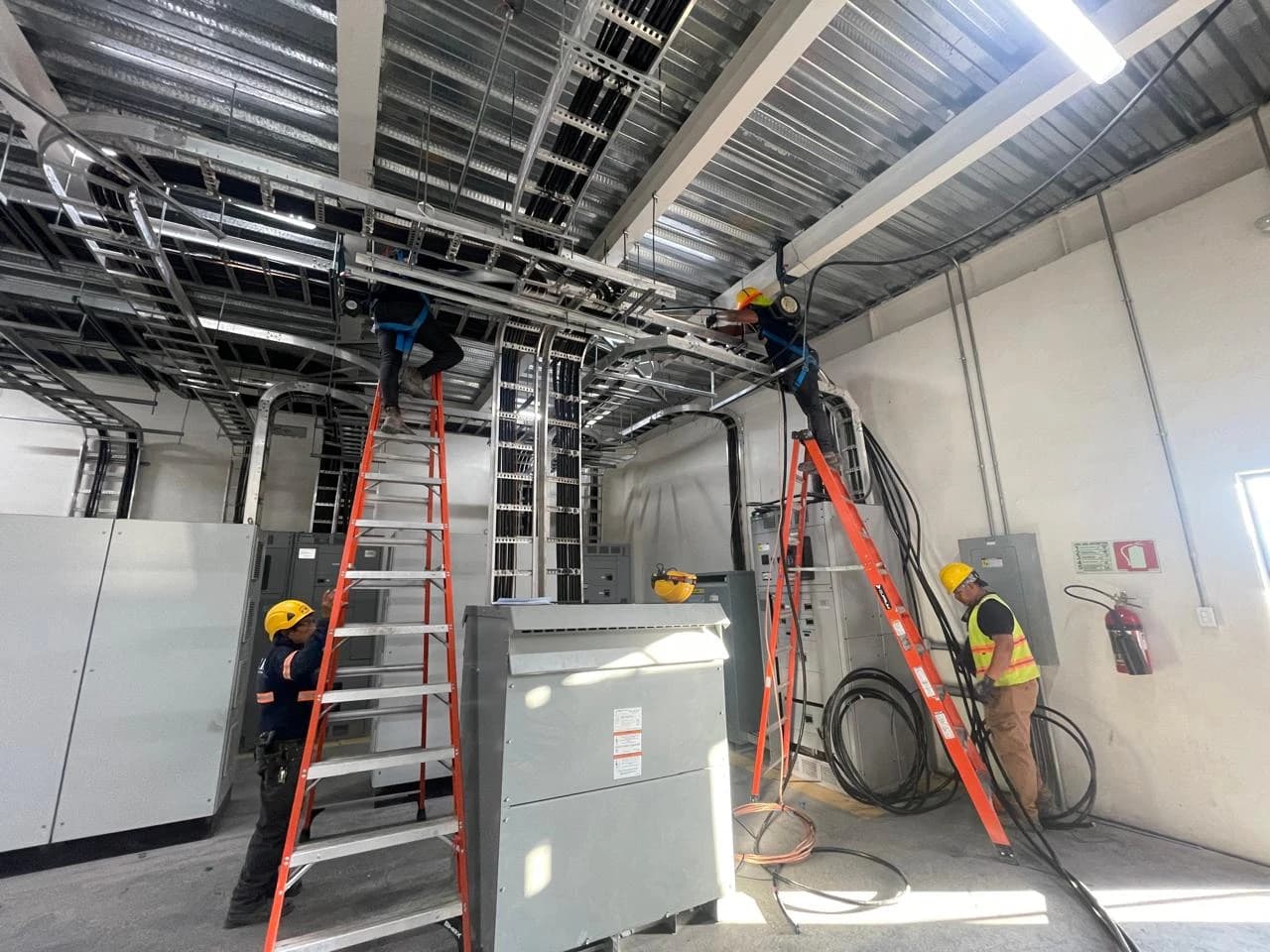
For the electrical scope, STAR installed the power feeder from Substation 2 to the panels supplying the ammonia refrigeration compressors. The installation covered approximately 250 meters of routing, with work performed at heights of up to 12 meters.
The feeder used 500 kcmil conductors installed in industrial Crouse-Hinds aluminum conduit. Routing and pulling large conductors across interior and exterior structures required coordination with the piping network, supports, and other services present in the plant.
Electrical distribution was integrated with power panels equipped with busbars rated up to 1,200 amperes and Siemens circuit breakers. These panels were connected to the main feeders and to the supplies serving the compressors and auxiliary refrigeration equipment.
As part of the electrical quality-control process, insulation resistance tests were performed on the main feeder conductors and on the supply serving a 750 hp ammonia compressor. The main power circuit breaker connections were also inspected and torqued using a calibrated torque wrench.
These tests verified conductor integrity and proper mechanical tightening before final equipment integration. Technical measurements taken during the process supported the quality of the completed electrical installation.
The project required continuous coordination between refrigeration specialists, welders, electricians, mechanical installers, rigging personnel, and safety teams. Work took place across different plant levels and involved elevated access, heavy equipment movement, field fabrication, and connections around large-capacity industrial machinery.
The result was the expansion and integration of a complex refrigeration infrastructure composed of refrigeration equipment, ammonia and glycol networks, high-capacity electrical feeders, and auxiliary systems. STAR's multidisciplinary execution connected the different project disciplines within a coherent installation prepared for the subsequent operational stages of the system.
Technical execution organized by work fronts, with focus on installation, coordination and commissioning.
750 hp
Compressor power
1,200 A
Power busbar capacity
500 kcmil
Power conductor size
250 m
Electrical route installed
12 m
Maximum working height
- 01Multidisciplinary project completed for Mayekawa at a Coca-Cola plant.
- 02Integration of an industrial ammonia refrigeration system with a secondary glycol circuit.
- 03Expansion and interconnection of the existing refrigeration network.
- 04Integration of Mayekawa compression equipment and a Güntner condenser.
- 05Field fabrication, fit-up, welding, and installation of piping.
- 06Installation of valves, fittings, flanged connections, and auxiliary components.
- 07Installation of supports and piping routes across interior and exterior structures.
- 08Application of insulation and metal cladding on the corresponding pipe sections.
- 09Installation of the power feeder from Substation 2 to the compressor electrical panels.
- 10Installation of approximately 250 meters of electrical routes at heights of up to 12 meters.
- 11Installation of 500 kcmil power conductors in Crouse-Hinds aluminum conduit.
- 12Integration of electrical panels with 1,200-ampere busbars and Siemens circuit breakers.
- 13Electrical connection and verification of the supply for a 750 hp ammonia compressor.
- 14Insulation resistance testing on the main feeder conductors.
- 15Connection verification and torquing using a calibrated torque wrench.
- 16Rigging, movement, and positioning of large industrial equipment.
- 17Use of cranes, articulated lifts, chain hoists, slings, and rigging accessories.
- 18Coordination between refrigeration, piping, electrical systems, structures, and mechanical installation.
The project expanded and integrated the infrastructure of a large-scale industrial refrigeration system, connecting compression equipment, condensing equipment, piping, the glycol circuit, and high-capacity electrical power. Coordination between refrigeration, piping, electrical, and mechanical installation delivered an organized solution adapted to the plant's technical requirements.
Visual evidence

Have a project in mind?
Let's talk about your needs and we will present the most suitable technical solution.